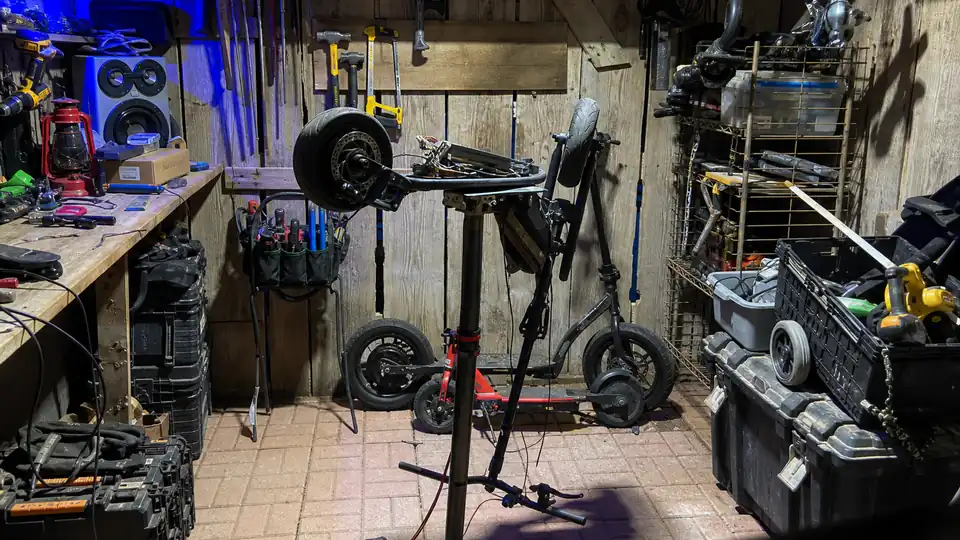
Build Your Dream Scooter

Four answers first. Engineering detail when you need it.

Planning calculator

Start with the ride you want.

Give it four basic answers. It will return one balanced starting point. The extra controls and engineering numbers stay out of the way until you open them.

Rough estimate

1. Four quick answers

What should the scooter do?

Blank fields widen the answer instead of blocking you.

Fine-tune the build optional

These settings improve the estimate, but beginners do not need them to get a useful starting point.

2. Balanced starting point

The system I would plan around

Enter a target speed to start narrowing the machine.

Show the engineering numbers
Compare safer and harder options
Check parts I already own optional

Open this only when you want to test a real battery, controller, or motor against the dream build.

Assumptions, limits, and builder checks

Exact formulas

  • Watts = volts × amps
  • Watt-hours = volts × amp-hours
  • Wheel circumference = π × diameter
  • Road speed comes from wheel RPM and circumference
  • Ideal no-load RPM ≈ KV × voltage

Bounded estimates

  • Loaded RPM is treated as a range below no-load RPM.
  • Range uses a low/high Wh-per-mile band plus battery reserve.
  • Grade power uses total estimated mass, speed, and slope.
  • Aerodynamic demand rises with the cube of speed.

Builder checks outside calculator logic

    Known limitations

    • Motor winding and efficiency maps are not known.
    • Battery voltage sag and controller current shaping are not simulated.
    • Traction, motor saturation, cooling, and duty cycle are not fully modeled.
    • Physical fitment and fabrication feasibility are deliberately excluded.
    Safety and legal limits

    This tool provides rough electrical and performance estimates for education and early build planning. It does not certify that a combination is safe, legal, reliable, physically compatible, or suitable for public-road use.

    Builder responsibility

    Verify brakes, frame and fork strength, wheel retention, mounting, wiring, insulation, connectors, fusing, cooling, weather protection, and safe testing.

    Speed and range

    Displayed speed and range values are estimates, not guarantees.

    Legal use

    Check local vehicle, speed, equipment, registration, and road-use laws.

    Safety

    Higher power and speed can increase stopping distance, heat, component stress, and injury risk. Cars always win.